
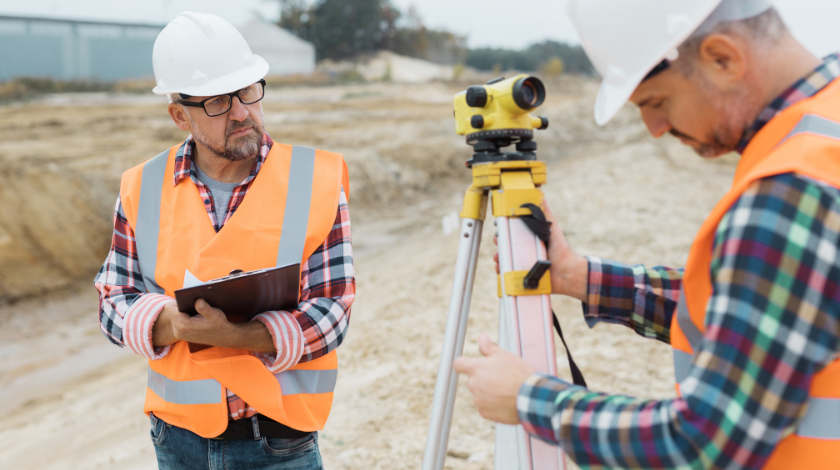
If you have ever bought a piece of land or tried to build a fence in your backyard, you might have heard someone say that you need to get a survey done. When I first started working in the construction industry years ago, I used to think that surveying was just one single thing where a person looks through a camera on a tripod and tells you where the grass ends. However, I quickly learned that it is much more complicated and fascinating than that. Surveying is actually the art and science of determining the terrestrial or three-dimensional positions of points and the distances and angles between them. It is the foundation of all civil engineering and land ownership. Without it, we would not have bridges, skyscrapers, or even clear property deeds.
The confusion usually starts when a client calls a surveying firm and asks for a quote, but they do not know what kind of survey they actually need. It is like walking into a doctor’s office and just saying you need “medicine” without explaining your symptoms. There are distinct categories of surveying that serve very different purposes. In this guide, I want to walk you through the five essential types of surveying. I will explain them in simple English so that by the time you finish reading, you will know exactly what is happening the next time you see a crew in neon vests standing on the side of the road.
1. Plane Surveying
Let us start with the most basic concept which is called Plane Surveying. When we talk about Plane Surveying, we are assuming that the surface of the earth is flat. Now, we all know the earth is round, but for small areas, the curvature is so minimal that it does not mess up the math. Imagine you are drawing a floor plan for a kitchen. You do not need to worry about the curve of the earth for a twenty-foot room. Plane surveying applies that same logic to small plots of land. This is the type of surveying used for most general construction projects, building sites, and small-scale property mapping. It assumes that a line connecting two points is a straight line and that the angles of a triangle add up to exactly 180 degrees.
In my experience, this is what ninety percent of people need when they are building a house or a small commercial building. Because the area is limited, usually less than a few hundred square kilometers, the error caused by ignoring the earth’s curve is negligible. Surveyors use standard tools like levels and theodolites here. If you are hiring someone to measure a lot for a new swimming pool, they are using the principles of Plane Surveying. It is faster, cheaper, and perfectly accurate for jobs where you are not measuring distances across entire states or countries. I always tell homeowners that unless they are building a pipeline across the continent, Plane Surveying principles are exactly what they are paying for.
2. Geodetic Surveying
On the complete opposite end of the spectrum, we have Geodetic Surveying. This is the heavy lifting of the surveying world. While Plane Surveying treats the world like a flat sheet of paper, Geodetic Surveying acknowledges that the world is an oblate spheroid. Basically, it takes into account the true curvature of the earth. If you draw a triangle on a curved surface, the angles actually add up to more than 180 degrees. If you tried to use Plane Surveying methods to map out a high-speed railway from New York to California, your measurements would be off by miles by the time you finished.
Geodetic surveys are used for very large areas. We are talking about mapping entire countries, establishing state boundaries, or setting up the control networks that other surveyors use as reference points. In the old days, this required incredibly complex mathematics and astronomy. Today, it relies heavily on satellite technology and GPS systems that are incredibly precise. I remember speaking with a surveyor who worked on a large interstate highway project, and he explained that without geodetic corrections, the two ends of the road would not have met in the middle correctly. This type of surveying provides the framework for everything else. It is highly specialized, and the average homeowner will likely never need to order a Geodetic survey personally, but we all benefit from the accuracy it provides to our maps and GPS navigation systems.
3. Topographic Surveying
Topographic Surveying is where things start to get visual and three-dimensional. While a standard boundary survey tells you the length and width of your land, a Topographic Survey tells you about the height and depth. It maps the natural and man-made features of the land. This includes trees, hills, creeks, retaining walls, utility poles, and buildings. The main goal here is to determine the elevation of different points on the ground. Surveyors create what are called contour lines on a map. These are the squiggly lines you might see on hiking maps where lines close together mean a steep hill and lines far apart mean flat ground.
I cannot stress enough how important this is for architects and engineers. I once saw a project get delayed for weeks because the initial survey did not accurately capture a steep slope on the back of the property. The architect designed a house that physically could not be built without expensive retaining walls that nobody had budgeted for. If they had invested in a proper Topographic Survey from the start, they would have seen the elevation change and designed around it. This type of survey is critical for drainage planning as well. You need to know which way the water is going to flow when it rains so you do not flood your new basement. If you are planning any kind of development that involves moving dirt or pouring concrete, a Topographic Survey is absolutely essential.
4. Cadastral Surveying
Cadastral Surveying is likely what comes to mind when you think of property disputes and buying a home. This is the branch of surveying that deals with the establishment and re-establishment of real property boundaries. It is heavily tied to the law. A Cadastral surveyor does not just measure land; they research legal records, look at old deeds, find historical markers, and interpret the intent of previous owners. They are essentially land detectives. Their job is to define where your ownership ends and your neighbor’s begins.
I have seen friendships end over six inches of grass. It sounds silly, but when you are building a fence or a garage, crossing the property line can lead to lawsuits and orders to tear down your construction. A Cadastral survey produces a plan that shows the boundaries, the easements, and the encroachments. An easement is a part of your land that someone else has a right to use, like a utility company running a power line. An encroachment is when a neighbor’s shed is sitting three feet onto your property. I always advise people to get a Cadastral survey before they close on a house. You need to know exactly what you are buying. Just because there is a fence there does not mean that the fence is actually on the property line. In fact, in my experience, fences are wrong more often than they are right.
5. Hydrographic Surveying
Finally, we have Hydrographic Surveying. This is the wettest of the five types. This method deals with mapping bodies of water. It measures the depth of the water and maps the terrain of the floor of oceans, rivers, and lakes. It also looks at the shoreline and the tides. You might wonder who needs this. Well, anyone who drives a boat needs it. Just like we need maps for roads, ships need nautical charts to know where the deep water is so they do not run aground.
Hydrographic surveying is also vital for offshore oil drilling, dredging operations, and building bridges or docks. The technology used here is fascinating. Surveyors use sonar sensors attached to boats that bounce sound waves off the bottom of the ocean to create a picture of the terrain hidden underwater. I find this type of surveying incredible because you are mapping something you cannot physically see with your eyes. It is also used for environmental monitoring. For example, if a river is silting up and causing flooding, a Hydrographic survey can determine how much mud needs to be removed to restore the flow. It is a highly technical field that requires knowledge of tides, acoustics, and marine navigation.
Why Experience and EEAT Matter in Surveying
Now that we have covered the five types, I want to take a moment to talk about why the person behind the equipment matters. In the world of SEO and content, we talk about EEAT, which stands for Experience, Expertise, Authoritativeness, and Trustworthiness. These same principles apply to hiring a surveyor. Today, you can buy a cheap laser measure or a handheld GPS online, but that does not make you a surveyor. The equipment is only a tool. The real value lies in the surveyor’s ability to interpret data and apply legal principles.
I have seen people try to save money by hiring the cheapest option, only to find out later that the survey was done incorrectly. An unlicensed or inexperienced person might miss an easement on a deed or misinterpret an old stone marker in the ground. I remember a case where a surveyor missed a drainage easement, and the homeowner built a pool right over a major municipal pipe. They had to dig the pool up at their own expense. That is a nightmare scenario. When you hire a professional Licensed Land Surveyor, you are paying for their liability insurance, their education, and their years of mentorship. You are paying for the peace of mind that the legal document they hand you will stand up in court. In my opinion, land is usually the most expensive asset a person owns, so it makes no sense to skimp on the one service that verifies what that asset actually is.
The Role of Technology
The field of surveying has changed drastically in the last twenty years. We have moved from chains and compasses to drones and satellites. Drone surveying, or aerial photogrammetry, is becoming huge for Topographic surveys. A drone can fly over a large site and take thousands of photos which are then stitched together to create a 3D model of the ground. This is faster and safer than sending a human to walk up and down dangerous stockpiles of rocks at a quarry.
However, technology has its limits. A drone cannot dig a hole to find an iron rod buried under six inches of asphalt. A GPS satellite cannot read a handwritten deed from 1850. This is why the human element remains so crucial. The best surveyors combine modern technology with old-school detective work. They use the satellites to get close, but they use their shovel and their brain to find the truth.
Conclusion
To summarize, surveying is not a one-size-fits-all profession. It is a complex field with distinct specializations. Plane Surveying handles our daily construction needs on flat planes. Geodetic Surveying connects the world by accounting for the earth’s curve. Topographic Surveying gives us the 3D shape of the land for design. Cadastral Surveying protects our legal rights and property boundaries. And Hydrographic Surveying maps the world beneath the water.
Understanding these differences protects you as a consumer. It helps you ask the right questions and order the right service. Whether you are a developer planning a skyscraper or a homeowner putting up a privacy fence, there is a specific type of survey designed for your project. My final piece of advice is to always communicate clearly with your surveyor. Tell them exactly what you are trying to achieve. If you do that, they can recommend the right method, save you money in the long run, and ensure your project stands on solid ground.
Frequently Asked Questions (FAQ)
Q: How much does a land survey cost?
A: The cost varies significantly based on the type of survey, the size of the land, the terrain, and your location. A simple boundary survey for a small residential lot might cost between $500 and $1,000, while a complex Topographic or Geodetic survey for a large development could run into the thousands or tens of thousands.
Q: Do I need a survey to build a fence?
A: In most cases, yes. Even if your local government does not legally require it, it is highly recommended. Building a fence based on a guess can lead to you building on your neighbor’s land, which means you might have to tear it down later. A Cadastral survey gives you the exact line.
Q: Can I find my own property pins?
A: You can try, but it is risky. Property pins are often buried or moved over time. Sometimes, what looks like a property pin is actually just a piece of scrap metal or a utility marker. A licensed surveyor has the tools to locate the correct markers and verify them against the legal description.
Q: What is the difference between a Geodetic and Plane survey?
A: The main difference is the curvature of the earth. Plane surveying assumes the ground is flat and is used for smaller areas. Geodetic surveying calculates the earth’s curvature and is used for very large, precise projects that span great distances.
Q: How long is a land survey good for?
A: Technically, a survey represents the conditions at the time it was made. However, as long as you have not sold off pieces of land or added new structures, a survey can remain useful for many years. Most title companies and banks will require a new or updated survey (usually less than 6 months to a year old) when property changes hands to ensure no new encroachments have occurred.